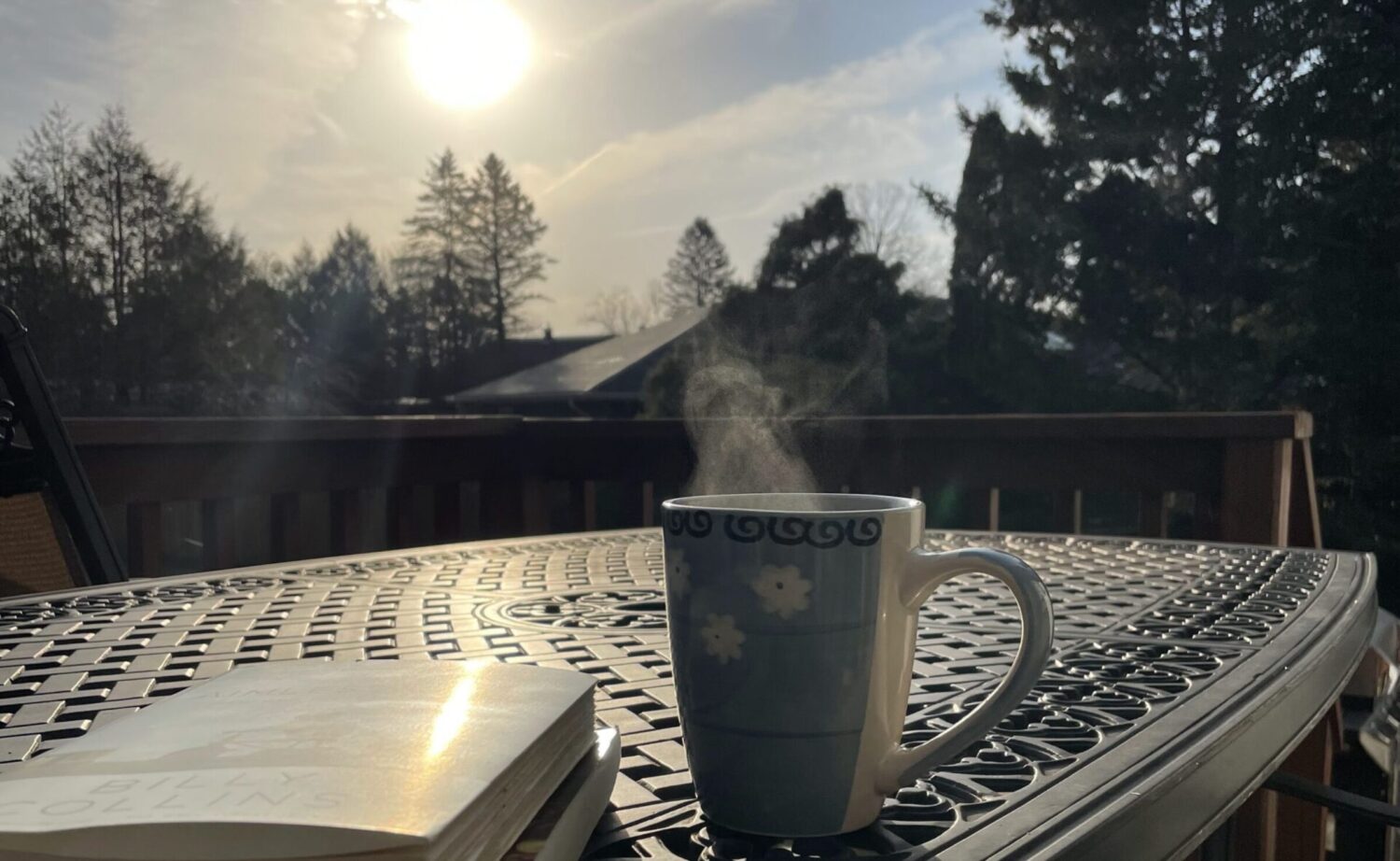
This morning I went for a walk. That, in and of itself, is not extraordinary. I go for lots of walks. What I did differently on today’s walk was to listen to two podcasts while I walked: one on the psychological benefits of art, and one on hopelessness, grace, and stamina. Both allowed me to get deeply lost in the conversation while also thinking about my own relationship to the content.
I used to listen to podcasts a lot more than I do now. Because of the types of podcasts I listen to (usually focused on how to live a full life, or how to live without judgment, or how to find joy and wonder – all interconnected variations on a theme), I often emerge feeling more contemplative, more grounded, and more questioning towards my own preconceived notions and certainties about how the world works. Often, I’ll think of areas of life where I might do better. Sometimes, I’ll be inspired to push or explore or make changes in my life and habits. Today’s listening session was no different.
The podcast about art (an episode of Hidden Brain) had me frustrated at times – not because of the content, but because of the format. Early on, the host, Shankar Vedantam, reminded the listeners that if they want additional content, they can subscribe to Hidden Brain Plus. This reminder was followed by an advertisement in Vedantem’s narration for Land Rover with its god-awful advertising speak that sounds like it’s from a J. Peterman catalog: “Even the boldest journey starts small” and “Purpose-built and courage-driven…” and “It looks tough because it is.” These phrases hit my ear dripping with inauthentic advertising speak that’s meant to sound authoritative, inspiring and bold. It’s not. Moreover, few things feel as antithetical to a conversation about the soul-enriching value of art as a reminder of the over-commercialized, enshittified hellscape in which we currently live. I hate that so many forms of content have succumbed to the freemium subscription model while still hitting us with ads (Disney just announced that there will be ads on all of their subscription tiers). I don’t care how “calming” Vedantam’s voice might be, it becomes disorienting and distracting and feels wholly inauthentic when he’s shilling for the Land Rover Defender. How to live a full and enriching inner life brought to you by Depends Undergarments.
Aside from the minor distractions of commercialism, for much of the podcast on art, I thought about my personal relationship with the arts, my shortcomings in those relationships, and who in my life has shaped how I think and feel about art. I have, admittedly, an uncomfortable internal relationship with the arts. One that’s full of desire, self-doubt, imposter syndrome, and guilt. I love the arts, would like to be better at some, and also shy away from them, or worry that I don’t practice or appreciate them in the “right” way.
From a very early age, the only artistic avenue I can ever remember being encouraged to pursue was writing. Even so, much of that encouragement was primarily focused on the essay (what I liked about this book or our trip somewhere) as opposed to creative writing – though I did attend school district-wide “young authors” conventions in first and second (or third) grade. As for other art forms, we (my brother and I) went to lots of museums and plays, and our family had an extensive collection of albums (mostly rock and popular music from the 50s, 60s, and 70s). We had prints of paintings from Chagall and Picasso hanging in the house, along with some big books on art history. We spent countless hours in bookstores. The hours in bookstores made my stomach churn the way a bored and anxious child might get a stomach ache. Visiting museums felt somewhat arduous and academic – this is where not appreciating art in the “right” way comes from. Plays were similar – they were serious plays by serious writers. Seldom did we experience art for the whimsy and playfulness of art. Art for the sake of art. Perhaps most telling of my earliest conflicts between arts and academics (in which academics always seemed to win out) was the day in Kindergarten when I broke down crying because I was sent to a first grade reading class while the rest of my kindergarten peers got to finger paint. I think the only way they could console me was to let me skip the next activity and do finger painting by myself.
As I continued to listen to the podcast about the benefits of art, I found myself wishing I could dedicate more of my time to artistic pursuits. This is when doubt and shame creeps in to my thinking. Most of the poems I submit for publication get rejected. As flawed as the thinking might be, it seems silly to want to put even more time into something where the arbiters of taste have routinely reminded me of my status as a novice unworthy of publication and greater dissemination. That, in turn, creates a whole lot of doubt. The shame I feel is over my lack of dedication (and education). Every attempt I’ve made at painting or learning music (or even writing) has been quickly abandoned or failed to take on the gravitas required to be remotely good. Apparently, I’m still struggling with art for art’s sake. If there’s hope, the psychobiologist being interviewed, Daisy Fancourt, said it takes about fifty hours of practice to get good enough to have the confidence to keep going, to overcome the sense of being incompetent and bad.
In addition to sticking with something for over fifty hours as a way of overcoming a case of the “I’m not good enoughs,” the podcast suggested finding was to socialize over art: join a class, visit museums and go to shows with friends and loved ones, join a discussion group or book club. Not only do I spend most of my social time socializing over beers, I’m bad at these things, or if not bad, mildly averse to them. I have two or three friends with whom I’ll go to concerts, and one of those with whom I might also see an exhibit or lecture. Most of the time, I do those more artistic related things by myself. The podcast had me wondering why I choose that path and the best answer I could come up with seemed tangentially related to intimacy. I don’t know many people on a deep enough level to connect over art, and while nobody says that you need to know someone on a deeper level to connect over art, I’ve gone on a few concert and museum first dates that seemed awkward precisely because it wasn’t something over which we had already been connecting. In short, spending time together at a museum or lecture or poetry reading feels like it requires a certain level of familiarity and care between people.
Over the years and in the spirit of looking for people who might inspire me, or at least help me improve in these areas, I’ve often found myself attracted to artistic types. Nearly everyone with whom I’ve had a somewhat serious relationship in the last ten years has had artistic tendencies: a school counselor who was also a painter; a marketing executive who was a graphic designer and had an eye for interior design; a copywriter who wrote poetry, painted, and also had an eye for interior design; and a nonprofit program manager who drew, painted, and created visual art. Any one of them could embody the type of person with whom I could imagine touring exhibits or attending plays and readings – though only two lasted long enough to get to the “let’s go to a museum” stage.
If the first podcast had me thinking that I need to expand my circle and find more ways to incorporate art into my life, the second one, the one about hopelessness and grace and endurance, had me wondering if I need to hang out with different people in general (especially different younger people). This podcast was a conversation about where we might find hope in a seemingly divided world. It was also about accepting that it’s ok to experience momentary bouts of hopelessness… to take a break, to rest, to catch our breath. The guest, author Jason Reynolds, talked about his work with young people and how they give him hope, but also how he’s been able to have uncomfortable conversations with people who seem to be on the other side of the issues as he is.
For much of this podcast, I found myself taking a hard look at the many assumptions I make about people, and how I would do better to show them more grace. I was thinking specifically of the young bros that hang out in my neighborhood on the weekends. I am particularly intolerant of them – enough so that I answer the dating profile prompt “My personal hell is…” with “surrounded by bros who are talking way too loudly in bro-speak. Damn kids… get off my lawn.” It’s true, I find them to be loud, boorish, and brain-rotted. Many of them objectify women and seem thoroughly stewed in the manosphere of 24/7 sports (and sports betting) as well as Joe Rogan, optimization (maxxxing), and tech/finance idolatry. I never hear them talking about art or music or social issues or politics. Instead, their conversations are almost exclusively about other people (their friends and romantic interests), money/work/travel, sports, or getting shitface drunk.
As I listened to Reynolds say he finds hope in young people, I thought of one specific young person I know and thought, if we have to put our hope in him, we’re cooked. “Chip,” who’s probably in his early- to mid-twenties, has a tendency to walk into the bar already tipsy and just say dumb, unkind, or annoying shit. One night he and my friend came back in from a vape break and when Chip saw someone ordering a drink where my friend had been sitting. He said to my friend, “yo, you’re gonna tell this fuck-head to move, right.” Another time, he had wanted to go out for a vape break and shouted to the bartender, “yo, when you gonna change the rule and allow us to vape inside.” Tellingly, he begins most of his sentences with “yo” and they’re often in the demanding tone of a command. When the bartender ignored him, he shouted it again. When I told him it was a state law, he ignored me and shouted it a third time to the bartender. As I was listening to Reynolds advise that we put hope in young people and also show grace because they’re young and will do dumb, young people things, I began debating with myself. Maybe if I had a conversation with Chip in a different setting about other topics (art, literature, politics, social issues) I’d see a different side of him. Maybe if I look past his brash bro-ness, I’d see a more complicated and nuanced version of Chip. My gut tells me that I’m probably seeing all there is to see of Chip’s depths. Seeing no reason to find hope in Chip (he seems like an ass), maybe I need to spend time around other, less ass-like young people.
A little more than half-way through my walk and part-way through the second podcast, I passed two friends who were also out a for a walk. I hit pause, we said hi, gave fist bumps, and kept going. The one friend said, “nice win yesterday.” He was referring to the Eagles game. I replied, “it was,” even though I didn’t watch the game and couldn’t say if it was or wasn’t a nice win. Perhaps because of where my head was, this small interaction was another reminder of how if I want different conversations, I would do well to cultivate new and different kinds of friends. I don’t pay much attention to sports, yet most of the people hanging out at bars (at the least the bars where I hang out) not only pay attention to sports, but run multiple fantasy teams and bet on a lot of the games. I know enough to hold my own in these conversations, but I have little desire to learn more or become more invested. I have days when I crave a different kind of conversation.
When I started my walk, I hadn’t planned on listening to anything (though I brought my earbuds just in case). Once the idea crossed my mind, I debated it for minute: I enjoy my walks in which I don’t listen to anything and am fully present in the world vs. I miss listening to podcasts and being challenged to think deeply. I had to convince myself that both are equally good and it might be nice to do something different. What I hadn’t expected was to have both podcasts lead me to the same conclusion: that the antidote to hopelessness and the frustrations posed by modern life might be found in shaking things up and finding more ways to incorporate art and different people into my life. Whether or not I take any steps in that direction is yet to be seen, but there was a sense of validation in hearing that the effort/desire, no matter how small or muted, is worth it.