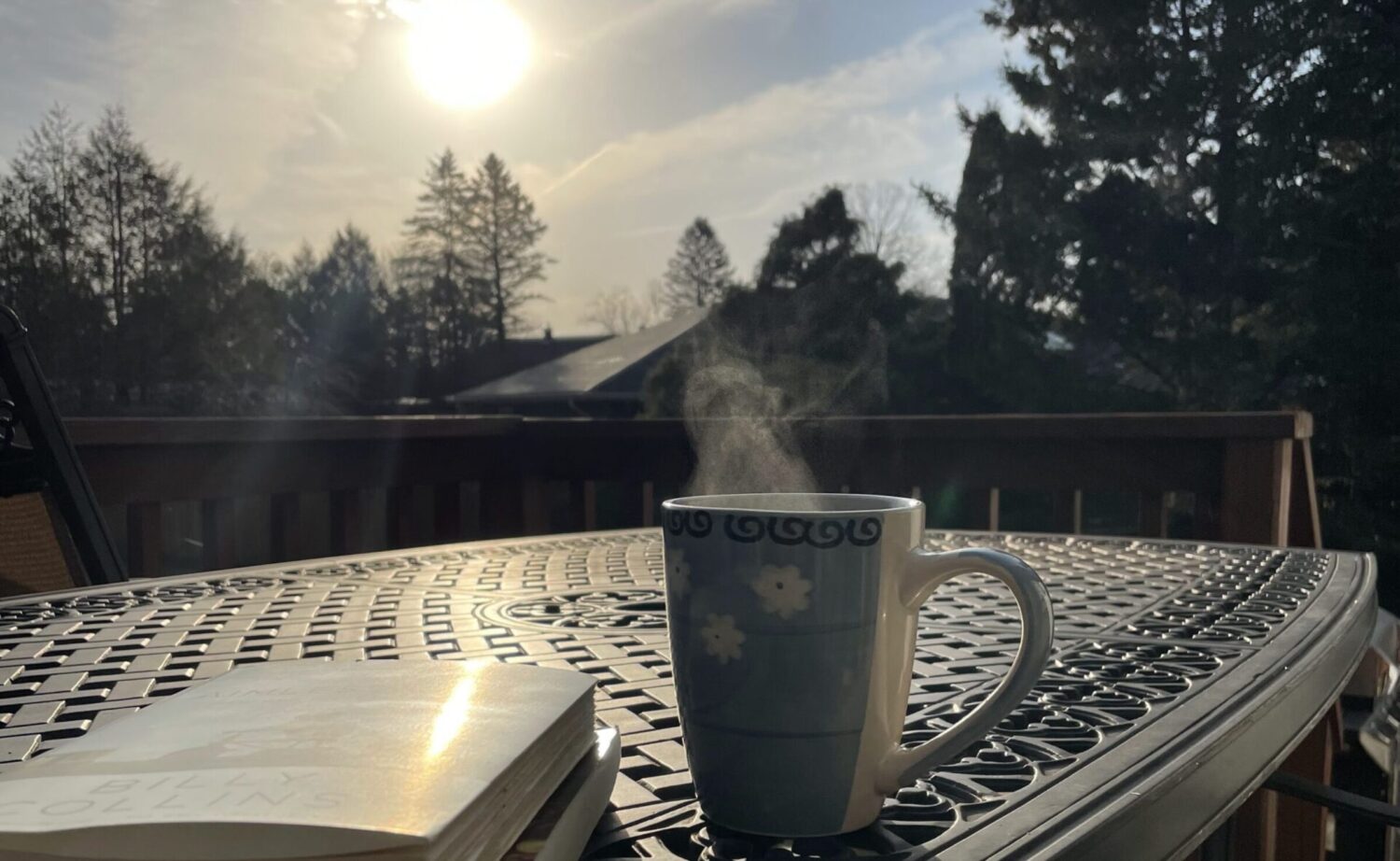
Two poems set my mind adrift. One, “Blowing on the Wheel” by Ada Limón recollects the speaker’s car rides with friends: “from Brooklyn to the Cape,” taxis in New York City, or driving on highways. The other poem, “Photocopying Memories” by Sean Thomas Dougherty, tells of how the speaker is charged with photocopying oral reports (memories) written down by the staff in a facility for brain injured patients and how one time the photocopies got mixed up. Both deal with the concept of memory – how we relive our experiences, especially when we share them with others.
I’m intrigued by the concept of memory. I’m intrigued by how we use our past to define our present, how it shapes us, how it becomes a small narrative in the broader narrative of our life. Moreover, I’m intrigued by what we choose to carry with us and/or share when we hit the reset button – on geography, a job, a relationship. How memories are reinforced in the retelling, become stronger the more we revisit them – shrink and fade when we abandon them.
With Limón’s poem, I was forced to face a future in which I don’t currently, and may never, have those types of connections. I’m not close friends with any of the hooligan’s I spent time with when I was younger. The one with whom I was closest passed away two years ago. The reminiscing ended with his death (though perhaps will live on in a future poem). Dougherty’s poem put me in more of a cerebral mood. What are memories anyway – especially if we can be convinced that ones we never had are real?
As a spiritual person with leanings towards Buddhism and the practice of being in the present moment, I sometimes find the concept of reliving memories challenging – as if in spending time remembering, I’m being a bad practitioner of presence. I will sometimes ask myself if I would undertake a good experience (let’s say the best meal I’ll ever eat) if I was told I’d forget it the moment the experience was over. I flounder every time I ask myself this question. It’s not so much that I wouldn’t undertake the experience (I want the meal), but I acknowledge that it somehow seems diminished if I can’t relive it in my memory. If I can’t remember it happening, what’s the value of having experienced it? Is it better to have loved and lost than to never have loved at all? If a tree falls in the woods… etc. etc. etc.
This little thought experiment hits home when I acknowledge the fact that I don’t spend much time reliving memories with the people who were there in the moment. My exes are all distantly somewhere else, some with other people. My childhood friends, the ones that remain, have drifted into other lives. It hits home when I think that almost all of my newer experiences (and memories) have been made on my own or with relative strangers: traveling across the country, living in Memphis, going to concerts, moving to San Francisco. It hits home when I think about my current friends, most of whom are newer, and I sheepishly acknowledge that it’s hard to imagine hanging out with them swapping stories 10 or 20 years from now.
Being set adrift meant thinking about how we share and with whom, but also about why we share. I recalled the handful of times when the sharing was generous because I was just getting to know someone on a deeper level. I remember visiting childhood homes with past partners as a way of seeing them re-live a slice of their life. Much like imagining talking to my current friends 20 years from now, that type of deeply getting to know someone seemed (and seems) foreign. Being set adrift also meant thinking about the interplay between experience and reflection, between living and sense making. In doing so, I went searching for two quotes that I had shared here on this blog years ago:
The important thing about having lots of things to remember is that you’ve got to go somewhere afterwards where you can remember them, you see? You’ve got to stop. You haven’t really been anywhere until you’ve got back home. – Terry Pratchett
Travel does not exist without home… If we never return to the place we started, we would just be wandering, lost. Home is a reflecting surface, a place to measure our growth and enrich us after being infused with the outside world. – Josh Gates
In my drift, I also thought about that travel thing a lot. I’ve been itching to go somewhere (though currently constrained by finances). I’ll pull up maps and scroll around (Spain or France). I’ll look at pictures of the Rockies or the deserts of the southwest. I’ll remember other trips – my various solo road trips (the night sky in Joshua Tree, the colors of Sedona, the art hotel in Winston-Salem) and then the trips taken with other people (Baltimore, the Baltic, Rome, San Diego, Clarksdale, Savannah). It’s not that one is better than the other, but the memories, perhaps because they were shared, seem a little richer when someone else was involved.
Where I arrived after my drifting was to conclude that I seem to be making fewer memories these days – or more specifically that because the memories I’m making are more solitary, they require a different type of attention, a different type of recollection. I can sense this change in the way I write. Many of the recent poems I’ve written have been more rooted in the physical world with details of the things I see on hikes and walks, a type of remembering, a type of sharing with the wider world.