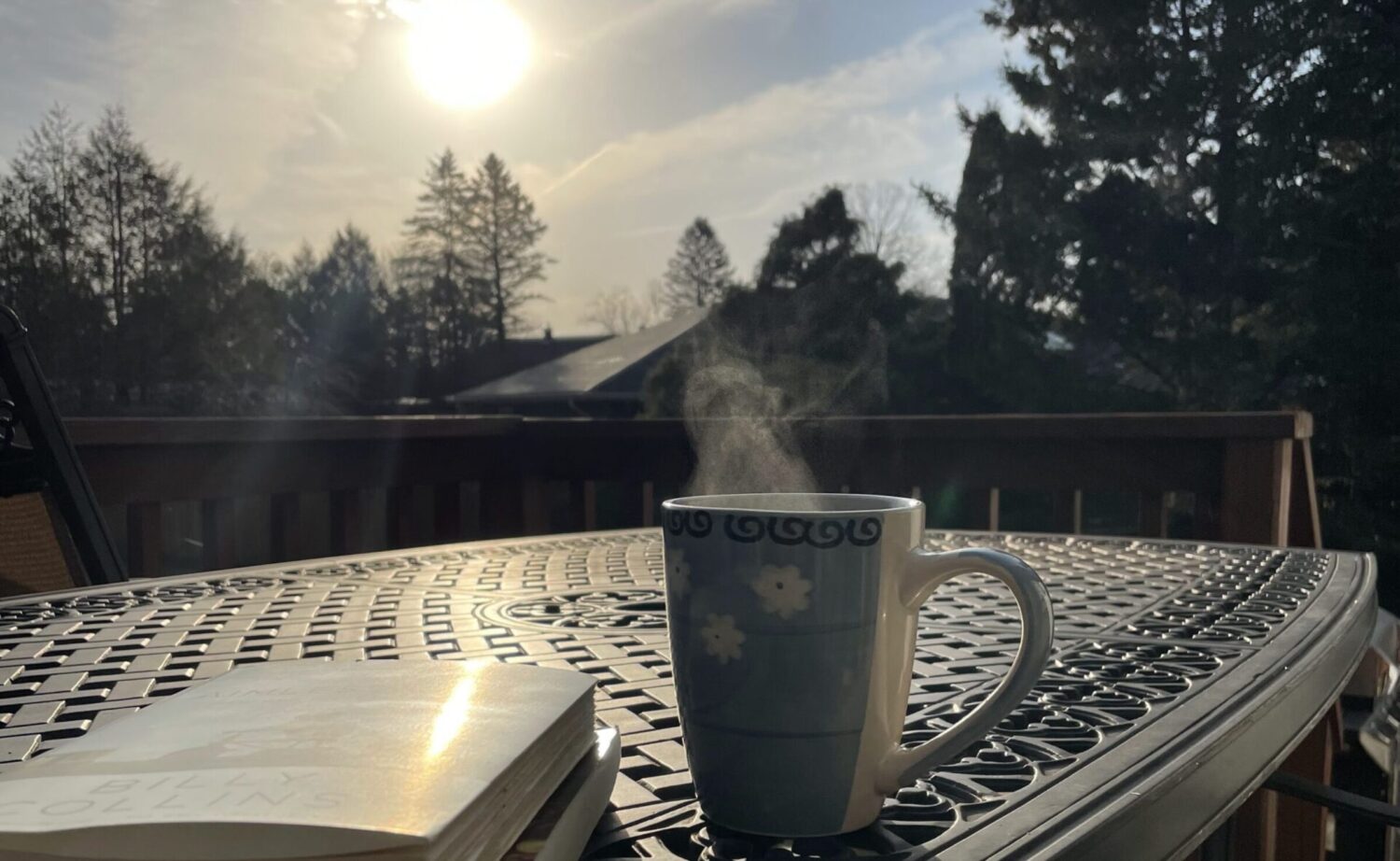
Feeling slightly on the mend from a week-long battle with some serious sniffles, I woke in the 5am dark. I shuffled out to the kitchen where I made coffee and bacon and frozen waffles. After breakfast, I read, I wrote, I named and saved the half-dozen open documents on my computer. At 6:30, it’s still mostly dark, but I open the blinds to catch the rising light – that soft yellow, pink, peach gradient rising behind the rooftops across the way.
Two poems, or maybe more than two, had me contemplating death. Stephen Dunn’s “Naturally” begins, “When I die there’ll be evidence / such as this / of a life, everything, all of it,” From Kim Addonizio’s poem “Invisible Signals” it was the line, “I like thinking about the friends I miss” followed by what those friends might be doing, “one with her twenty-four hour sobriety chip, / one making pozole while her dog / frets in its cage in the kitchen, one helping her sister drag / the oxygen tank to the bathroom.”
I imagined my own funeral in some distant future (if I’m lucky). I thought about that quiet moment of cleaning up after everyone has left. I couldn’t envision very many people attending. I expect my parents will have passed by then which leaves my brother’s family and my daughter and whatever family she’s built by then. There might be others, but I wouldn’t blame them if they only showed out of a sense of obligation.
The exercise, the meditation on my own passing, was sobering. Generally speaking, I don’t put much stock in legacies. Most of us will be forgotten within one or two generations. I suspect that within a year or two of passing, most of us will be forgotten by everyone outside of our immediate circle of close relatives and friends. Perhaps that says more about me than other people. Funerals, however, are more about short term legacies and the immediate impact we’ve had on people. This was the sobering part – that even in death, we want some sense of validation, some sense that we mattered. And the older we get, the more those weak bonds fall off and the smaller our circle (of impact, of kinship, of relevance) becomes.
The Buddhist in me knows better than to fall into this trap. The magnolia tree outside of my window does not worry about what happens when it is no longer a magnolia tree outside of my window. The poet in me says this is where I should spend a few light-hearted yet uncomfortable moments. How do I make the most of this space where nothing matters yet acknowledge that this is all we have. The optimist and humanist in me says there’s still time to change course or do something different or build different relationships with the world. There’s time to create art and community. That is, of course, until there isn’t. Maybe this is why I’m tempted to own a bar – to briefly be that person beloved by all (or at least by a few). Which isn’t that different than trying to write – a gentle pushing at the edges of being seen and understood, a light nudge at the false boundary the separates self from the outside world.
Dawn arrives unceremoniously. It’s lighter out. The sky is pleasantly undramatic – pale blue, hints of yellow, wisps of clouds. This is how it is, here and now. I should probably try to make something of it.